Cheers to press freedom:

Highlights from Perugia #IJF26

If we met up at the Hannah Arendt Initiative opening reception at #IJF26 in Perugia, it is wonderful to see you again. If not, no worries. Here are the key takeaways from four rooftop spotlights on journalist safety and resilience.

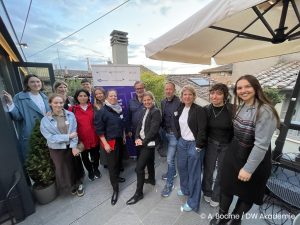
Many people stand in front of the rollup of Hannah Arendt Initiative and smile into the camera

In case we didn’t see you at the Hannah Arendt Initiative opening reception, we’ve gathered the most relevant insights from the event. The only thing you truly missed was one of the drinks served to the roughly 80 guests on the rooftop – and unfortunately, that’s something we can’t pass on online.

The evening kicked off with a brief introduction to the Hannah Arendt Initiative, followed by four concise project spotlights. Together, they offered insights, tools, and lessons from our global work to protect and support journalists – and reflected the Initiative’s core mission: strengthening the safety, resilience, and independence of media professionals worldwide.

Key takeaways from the rooftop spotlights

Abigaíl Hernández, a Space for Freedom fellow from Latin America, spoke about why safe spaces such as journalist hubs – developed by DW Akademie and, elsewhere in the world, also by MiCT together with partners – are essential. They combine professional development with psychosocial support.

As the exile community of journalists and media workers in Costa Rica continues to grow, she described DW Akademie’s hub as more than just a training venue:

“For us it is a special place because it’s not just a place for professional development courses in journalism. It’s a place for emotional catharsis where we come together for shared experiences and affinity. […] now we have the opportunity to use the house for meetings, for different events, journalistic events and that helped us to have some incomes in exile.”

Abigaíl Hernández, Nicaraguan journalist currently living in exile in Costa Rica

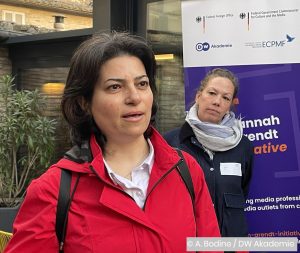
A woman in a red jacket seems to be speaking while another woman is seen in the background listening

Rana Akabani, manager of the MiCT protection program in West Asia and North Africa, and co-director of the North Africa Media Academy (NAMA), stressed that in protracted crises, journalistic resilience depends on support that is sustained, adaptable and not confined to emergency response. Drawing on examples from Gaza, Lebanon, Libya and other conflict-affected contexts, she described the precarious conditions many journalists face: living in refugee camps or tents or being forced to relocate repeatedly due to warnings and evacuations.

Nevertheless, many continue to work. Akabani also highlighted the often-overlooked strain on local teams and emphasized the crucial role that established safe spaces play in enabling journalists to carry on with their work.

“Our role in protection programs is to remain as flexible as possible. Also, every form of support matters, what may seem small, rarely is.”

Rana Akabani, co-director of the North Africa Media Academy (NAMA)

How exiled media are pushed to constantly innovate under adverse conditions was the focus of a fellow of JX Fund’s Newsroom Pivot Program. She leads the membership program and is also the English editor at CONFIDENCIAL. For security reasons, she wished to remain anonymous.

Drawing on her experience working on audience and membership strategies, as well as collaborating with other exiled media, she highlighted the creativity and ambition behind many of the ideas developed across these newsrooms. The Newsroom Pivot Program equips exiled media leaders with strategic tools, enabling them to navigate complexity, build sustainability and deliver journalism that remains vital and relevant to the communities they serve.

“Knowing what to do doesn’t mean you can actually do it,”

she noted, pointing to limited capacity as the main constraint.

“Impact isn’t just about what we learn. It’s about how much of it we’re able to implement,”

she added, emphasizing that with small teams and scarce resources, even proven models struggle to grow without sustained structural support.
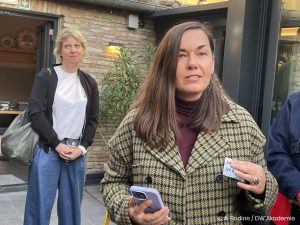
A woman in a coat holds a phone in her right hand, with another woman in the background

Oksana Brovko, CEO of the Association of Independent Regional Press Publishers of Ukraine – a partner of ECPMF’s Voices of Ukraine program – focused on the need to institutionalize security and insurance systems during wartime to build long-term resilience. She recalled that before the war, no dedicated insurance solutions for Ukrainian journalists existed:

“A journalist told me: ‘I’m not afraid to go to the frontline. I’m afraid of what will happen if I won’t come back. What will happen with my family? With my newsroom? With my team?’ And of course, insurance does not stop the danger but it helps take a decision.”

Oskana Brovko, CEO of the Association of Independent Regional Press Publishers of Ukraine

The Initiative’s mission was not only visible on the rooftop that evening, but also across multiple panels throughout the 20th International Journalism Festival.

Missed the sessions?

No worries. Watch them on demand:

ECPMF:
Ukrainian journalism under fire: media resilience in the fifth year of war

Moderated by Olha Syrotiuk.
Organized in association with Lviv Media Forum in partnership with the European Centre for Press and Media Freedom.

DW Akademie:
Unseen burdens: the invisible backpack of women journalists in exile

Moderated by Nadine Jurrat.
Sponsored by DW Akademie.

JX Fund:
Authoritarian convergence: how Russia, Iran and China reshape information ecosystems

Moderated by Filip Noubel.
Organized in association with JX Fund.

Freedom’s lifeline or lawless frontier? Understanding Telegram’s role in global media

Moderated by Alex Vorobev.
With Maral Jekta (JX Fund).
Organized in association with The Fix.


Logo of Hannah Arendt Initiative in orange and violet plus claim: "Protecting media professionals and media outlets from crisis regions".


The Hannah Arendt Initiative is a program of the German Federal Government.
The Initiative’s projects are funded by the German Federal Foreign Office and the Federal Government Commissioner for Culture and the Media (BKM).